


Daart Ads Digital Advertising Platform: From Awareness to Performance
A digital advertising platform becomes more valuable when it does more than place ads in individual channels. Its real job is to help a business connect awareness, acquisition, engagement, and conversion around a shared objective—then measure what happens across that journey.
That sounds obvious, yet many marketing teams still manage campaigns as isolated activities. One report focuses on impressions, another on cost per install, another on leads, and another on sales. Each number may be accurate on its own, but the business can still struggle to answer the most important question: which activities are moving the company toward a meaningful outcome?
Daart Ads presents its English offering as a digital advertising platform with banner advertising, push notification advertising, and performance-based campaign options, including CPC, CPM, CPI, CPA, and CPL models.1 This article explains how to place those options inside a connected operating framework. It is not a promise of results: campaign performance also depends on the product, offer, competition, creative quality, landing-page experience, budget, data quality, and the way a business defines a valuable conversion.

The short answer: what should a connected advertising ecosystem do?
A connected advertising ecosystem gives every channel a clear role in the customer journey. It does not require every business to use every channel. It requires the channels that are used to support a common business goal, work with consistent data, and produce reporting that leads to a decision.
A simplified journey may look like this:
Awareness → qualified visit or app install → activation or lead qualification → engagement or return → conversion and value
The first interaction rarely tells the whole story. Google Analytics notes that people may search, view, and click multiple marketing touchpoints before they complete a key event; attribution is the process of assigning credit across those interactions.2 That is why the lowest-cost click, install, or lead is not automatically the best outcome for the business.
A useful way to organize the journey is below.
| Business objective | Role in the journey | Relevant campaign options on Daart Ads | Starting metric | Quality guardrail |
|---|---|---|---|---|
| Improve awareness | Put a relevant message in front of a defined audience | Banner campaigns, CPC or CPM approaches | Reach, impressions, clicks | Traffic relevance, engaged visits, brand interest |
| Grow an app user base | Turn qualified attention into valid installs | CPI or other app-install campaigns | Valid installs, CPI | Registration, activation, first meaningful action |
| Generate demand | Turn interest into a defined business action | CPL or CPA campaigns | Qualified lead or verified action | Sales acceptance, meetings, opportunities, revenue |
| Re-engage known audiences | Continue a relevant conversation after a prior interaction | Push notification advertising | Return visit or click | Completed action, opt-out rate, post-click value |
| Improve budget decisions | Compare effort and value across the journey | Shared measurement and reporting | Cost and attributed conversion value | Margin, customer quality, retention, profitability |
The table is not a channel-selection formula. It is a reminder that a channel should be selected for the role it can play in the customer journey—not because a single metric looks attractive in isolation.
Why multiple campaigns often fail to become a system
Marketing operations become fragmented in predictable ways. The acquisition team reports installs. Sales reports lead quality. A brand team reports reach. Finance asks about total investment. Each perspective is legitimate, but without a common structure, teams optimize for local wins rather than business progress.
A connected system usually needs five foundations.
Start with the change the business needs to create—not with the media format that seems cheapest. A new app may need activated users rather than raw installs. A B2B company may need qualified meetings rather than form fills. An ecommerce business may need profitable completed orders rather than the highest possible order count.
The outcome should be specific enough that the marketing, sales, product, and finance teams can recognize it in the same way.
2. A consistent definition of a valid conversion
A conversion can be a purchase, a registration, an install, a submitted form, a requested demo, or another action. The label is less important than the definition behind it.
For example, a “qualified lead” might require contact information that can be verified, a fit with the target market, and a demonstrated need. A “valid install” might exclude duplicate, fraudulent, or immediately uninstalled applications. An “approved order” may exclude cancelled or refunded transactions.
Without these rules, a platform can optimize toward the event that is easiest to generate instead of the event that is most valuable to the business.
3. A coherent message from ad to destination
An ad, landing page, app-store listing, form, or onboarding flow should feel like one conversation. If the ad promises a specific benefit and the destination introduces a different offer or adds unnecessary friction, conversion performance becomes harder to interpret.
Before launch, review the journey from the user’s point of view:
- Does the landing-page headline reflect the promise in the ad?
- Is the value proposition clear to a new visitor?
- Is the call to action suitable for this stage of intent?
- Does the next step feel proportionate to the action you are requesting?
- Are mobile and desktop experiences both usable for the audience you are targeting?
Campaign naming, UTMs, conversion events, and reporting windows can feel like operational details. They are not. They are the bridge between delivery data and business decisions.
At minimum, document the following before spend begins:
- What is the primary event, and where is it recorded?
- Which source, medium, campaign, and creative identifiers will be used?
- How will duplicates, invalid events, or late conversions be handled?
- Which costs are included in the campaign view—media only, or also creative, discounts, technology, and operations?
- Which attribution model and conversion window will the report use?
Google Analytics offers several attribution models, including data-driven attribution and last-click views.2 No model removes the need for judgment, but documenting the model prevents teams from comparing numbers produced under different rules.
5. Reporting that produces a next action
A report should not end at “what happened.” It should help the team decide what to do next. At the end of a reporting period, ask:
- What did we learn about the audience, message, offer, or destination?
- Which assumption was supported or disproved by the data?
- What single change will we test next, and which metric will determine whether it worked?
That habit turns reporting from a monthly archive into a learning system.
A six-step framework for using a digital advertising platform
Step 1: Start with the business bottleneck
Do not begin with “Which format is the cheapest?” Begin with “Where does our current customer journey lose the most value?”
The bottleneck may be insufficient awareness, low-quality acquisition, an activation problem after install, weak lead follow-up, a confusing landing page, or poor repeat engagement. Different problems require different campaign roles. Starting with the bottleneck keeps the plan grounded in the business rather than in a list of available formats.
Step 2: Build a metric tree, not a single-metric target
A single primary metric creates focus. Complementary metrics protect quality.
| Situation | Primary event | Supporting metrics |
|---|---|---|
| New mobile app | Valid install or completed registration | Activation rate, first key action, retention |
| B2B offer | Sales-qualified lead | Contact rate, meeting rate, opportunity rate, contract value |
| Ecommerce campaign | Confirmed purchase | Gross margin, refund rate, average order value, repeat purchase |
| Re-engagement program | Return and completed action | Opt-out rate, post-click conversion, customer value |
This structure is useful because it prevents an easy-to-measure activity from becoming the only definition of success.
Step 3: Match the channel to the stage, not the channel to the team
Different campaign types can be valuable at different stages:
- Banner advertising can help introduce a relevant message, test creative angles, and build awareness with a defined audience.
- CPC and CPM approaches may be appropriate when the immediate purpose is traffic or visibility, provided the business also evaluates the quality of the attention received.
- CPI campaigns can support app growth when installations are monitored alongside activation and post-install behavior.
- CPL and CPA campaigns can bring measurement closer to a lead or defined action, but the definition and validation of that action must be agreed on first.
- Push notification advertising can help re-engage users who have already encountered the brand, when messaging, timing, frequency, and audience segments are handled responsibly.
Daart Ads lists these kinds of campaign options on its English platform pages.1 The operational question is not whether one channel is universally better than another. It is whether the channel has a clear job in the journey and whether the business can measure its quality.
Step 4: Prepare measurement before launch
Measurement retrofitted after a campaign begins is often incomplete and costly to repair. Before launch, run a short test journey: click the ad, arrive at the destination, complete the intended event, and confirm that the event, source identifiers, and destination data appear where expected.
For a B2B program, this may mean linking the lead source to CRM stages such as contacted, meeting held, opportunity created, and closed won. For an app, it may mean checking that the install, registration, activation, and first transaction are not treated as the same event. For ecommerce, it may mean validating the distinction between an order placed and an order that is confirmed, fulfilled, or refunded.
Step 5: Test one meaningful hypothesis at a time
Changing the audience, creative, offer, landing page, and budget all at once makes it difficult to learn from the result. Instead, formulate one clear hypothesis.
Examples:
- If a returning user sees a message related to the product category they viewed, the completion rate may improve.
- If the landing page removes a non-essential field, more qualified prospects may finish the request flow.
- If optimization moves from app installs to completed registration, the quality of acquired users may increase.
For each test, record the audience, change, primary metric, guardrail metric, time frame, and the decision rule that follows the result.
Step 6: Move budget toward business value
Budget allocation should reflect the best available evidence about value, not just the lowest media cost. A low CPI may not help if activation is weak. A low CPL may not help if sales cannot qualify the leads. A strong return on ad spend may not mean that a campaign is profitable after margin, discount, fulfilment, and operating costs are considered.
The practical approach is to review media metrics, conversion quality, and business value together. That gives the team a stronger basis for maintaining, increasing, reducing, or stopping spend.
Three common scenarios
Scenario 1: An app with many installs but weak activation
A growing app may see installations rise while registrations or first key actions remain low. The problem may be the audience, the ad promise, the store listing, or the onboarding experience—not necessarily the install channel itself.
The next useful step is to preserve CPI as a diagnostic metric while adding activation or first key action as a quality measure. This shifts the conversation from “How can we buy cheaper installs?” to “How can we acquire users who are more likely to experience value?”
Scenario 2: A B2B company with many leads and few meetings
A B2B campaign can generate form submissions that look efficient in the marketing dashboard but fail to progress through sales. The fix is not automatically to lower CPL further. First, align marketing and sales on the definition of a qualified lead, make CRM outcomes visible in the report, and identify whether the issue is audience fit, message clarity, lead routing, or follow-up capacity.
In this case, the cost per accepted lead or cost per booked meeting may be more useful than cost per form.
Scenario 3: An ecommerce campaign with strong revenue but weak margin
A campaign can show good attributed revenue while prioritizing low-margin products or deep discounts. The media report looks healthy, but the business result may be less attractive after direct costs, returns, and discounts are included.
A stronger operating model adds margin-aware reporting or at least a product-level quality check. The goal is not to reject revenue metrics; it is to put them in the right context before decisions are made.
When does an integrated operating model help most?
A connected operating model can be especially useful when several teams touch the same customer journey, when the business uses more than one campaign type, or when reporting needs to connect media activity to downstream outcomes.
It can reduce coordination friction by creating common definitions and a shared reporting language. It can also make experimentation more disciplined because the team can distinguish an awareness signal, an acquisition signal, and a business outcome.
However, integration should not mean forcing every activity into one vendor or one dashboard. A specialized channel can still be managed by a separate expert when that is the best option. The important point is that campaign roles, conversion definitions, and reporting conventions remain connected.
Ten questions to answer before you launch
- What business outcome is the campaign intended to influence?
- What event counts as a valid conversion?
- Which audience and stage of the journey does the campaign address?
- What role does this channel play: awareness, acquisition, engagement, or conversion?
- Which message and destination will the user encounter?
- How will campaign source and creative be tracked?
- Which costs are included in performance calculations?
- What supporting metric will protect conversion quality?
- What will the team test first, and what would count as a meaningful result?
- Under what conditions will the budget be increased, reduced, or stopped?
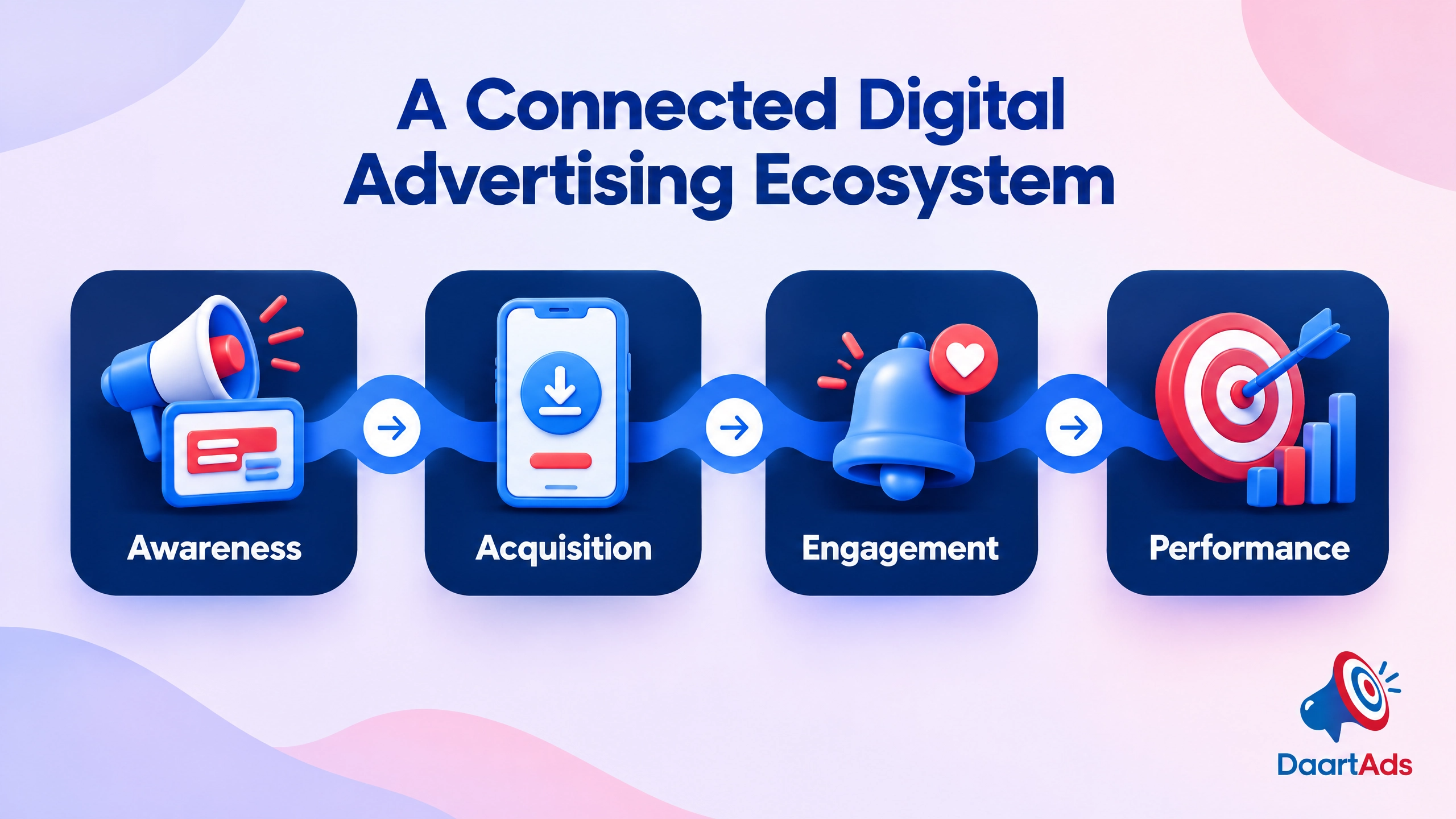
How Daart Ads fits into the workflow
Daart Ads describes its offering as a digital advertising platform that supports targeted campaign options, banner advertising, push notification advertising, and performance-focused campaign models.1 In practical terms, the value of a platform is highest when the business starts with a clear goal, matches campaign formats to the customer journey, prepares measurement before spend, and reviews quality alongside volume.
To explore the currently listed campaign options, visit the Daart Ads services page. For broader platform information and targeting options, visit the Daart Ads homepage.
Frequently asked questions
Does a business need every advertising channel to build an ecosystem?
No. An ecosystem is not a large media list. It is a coherent operating model. Use only the channels that have a clear role, a measurable event, and a logical connection to the customer journey.
Is a lower CPI or CPL always better?
No. Lower acquisition cost is useful only if the resulting users or leads produce meaningful downstream value. Pair acquisition cost with a quality measure such as activation, sales acceptance, meetings, margin, or repeat purchase.
What is the difference between a campaign metric and a business metric?
A campaign metric describes media delivery or a near-term action, such as impressions, clicks, installs, or form submissions. A business metric indicates whether the activity created valuable progress, such as an activated user, a qualified opportunity, a profitable sale, or retained revenue. Both are useful, but they answer different questions.
Can attribution tell us exactly which channel caused a conversion?
Attribution models distribute or assign credit based on defined rules and available data; they do not eliminate uncertainty. Use attribution to improve decisions, document the model and conversion window, and combine the view with real sales, product, or customer-quality data where possible.2
Does a connected campaign setup guarantee better results?
No. Coordination and better measurement improve the quality of decisions, but performance still depends on the offer, audience fit, competition, creative, destination experience, data quality, and budget. No campaign structure or platform can guarantee a specific business result.
Conclusion
A digital advertising platform should help a business do more than launch separate campaigns. It should support a disciplined path from awareness to acquisition, engagement, and measurable value.
The starting point is not a long list of formats. It is a clear business goal, a credible definition of conversion, consistent measurement, and a willingness to test one meaningful change at a time. When those foundations are in place, banner, app-install, push, and performance campaigns can become connected parts of a learning system instead of disconnected line items in a media plan.